In our lab, the first thing we do when a sample arrives from a Baltimore site is fire up the sieve shaker. We use a nested column of ASTM-standard sieves, from 3-inch down to the No. 200 mesh, to separate the coarse fraction. For the material that passes the No. 200 sieve, we run a hydrometer analysis to capture the silt and clay distribution. This combination gives us the full particle-size curve, which is critical for everything from estimating drainage characteristics to classifying the soil under the USCS system. Without that curve, you are essentially guessing at how the ground will behave under a slab or behind a retaining wall. We routinely process samples from Inner Harbor redevelopment projects and suburban residential lots alike, and the procedure stays consistent because the ASTM method is the same whether the soil came from a coastal plain deposit or a filled tidal marsh.
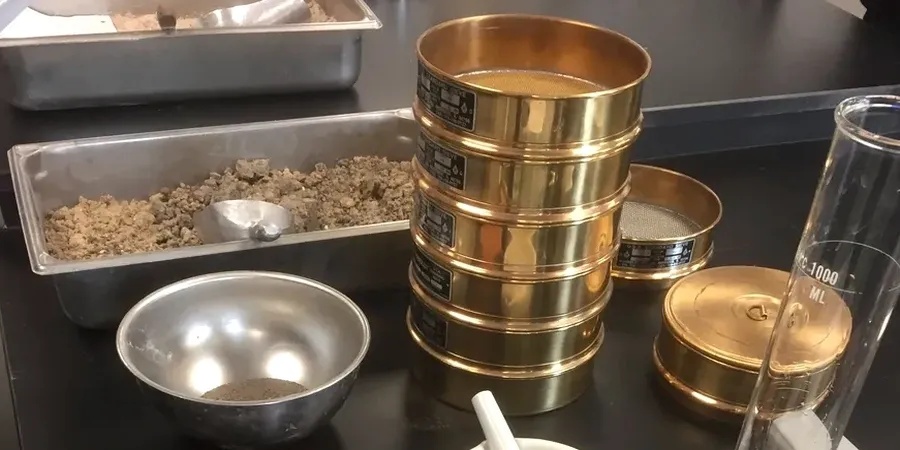
A full grain size curve from combined sieve and hydrometer analysis is the foundation for every soil classification we issue in Baltimore.
Method and coverage
Regional considerations
We saw a case in Fells Point where a contractor placed imported fill for a townhouse foundation without verifying the grain size. The material looked clean on the surface but turned out to be a poorly graded sand with almost no fines. After the first heavy rain, water infiltrated straight through, softened the subgrade, and the slab settled nearly two inches in one corner. A simple grain size analysis before placement would have flagged the problem. That is the kind of risk you avoid when you characterize the soil properly upfront. In Baltimore, where much of the urban area is built on man-made fill from the 19th and early 20th centuries, knowing the particle distribution is not optional — it is the first line of defense against differential settlement and drainage failures.
Process video
Standards that apply
ASTM D6913-17 (Standard Test Methods for Particle-Size Distribution of Soils Using Sieve Analysis), ASTM D7928-21 (Standard Test Method for Particle-Size Distribution of Soils Using Hydrometer Analysis), AASHTO T-88 (Particle Size Analysis of Soils)
Related services
Sieve Analysis (Coarse and Fine Fractions)
Full dry and wet sieve analysis per ASTM D6913 for gravel, sand, and silt-sized particles. We handle everything from 3-inch cobbles down to the No. 200 sieve. Results include cumulative percent passing and individual percent retained for each sieve.
Hydrometer Analysis (Silt and Clay)
For the fraction passing the No. 200 sieve, we run the hydrometer test per ASTM D7928. This gives you the distribution of silt (0.075 to 0.002 mm) and clay (<0.002 mm), which is essential for classifying fine-grained soils and evaluating shrink-swell potential.
Combined Grain Size Curve with USCS Classification
We merge the sieve and hydrometer data into a single continuous gradation curve and use it to assign the Unified Soil Classification System (USCS) group symbol and group name. This is the standard input for geotechnical reports, foundation design, and fill acceptance.
Typical parameters
Common questions
Why is grain size analysis important for construction in Baltimore?
Baltimore's soils range from clean sands in the Coastal Plain to high-plasticity clays in the Piedmont. The grain size curve tells you how the soil will drain, compact, and support loads. Without it, you risk using fill that does not meet compaction specs or building on a layer that will settle unevenly after rain. It is the first step in any soil classification.
How much does grain size analysis cost in Baltimore?
A combined sieve and hydrometer analysis typically runs between US$90 and US$190 per sample, depending on the number of sieves required and whether the sample needs washing or pre-treatment. The price includes the full gradation curve and USCS classification. Volume discounts are available for projects with multiple samples.
What is the difference between sieve analysis and hydrometer analysis?
Sieve analysis separates particles down to 0.075 mm (No. 200 sieve) by mechanical shaking. The hydrometer test takes over below that, using sedimentation principles to measure particles from 0.075 mm down to about 0.001 mm. You need both to get the complete gradation curve for soils that contain significant silt and clay, which is common in many Baltimore sites.