Under ASTM D2434, laboratory permeability tests quantify how water moves through soil pores, a property that directly influences drainage design and slope stability in Baltimore. The city sits above the Patapsco Formation, where interbedded sands and clays create anisotropic conditions that can mislead designers who rely on published tables rather than site-specific lab data. Our team has processed hundreds of samples from projects along the Inner Harbor and through the northern suburbs, consistently finding that falling head tests on fine-grained soils and constant head tests on sands yield the most reliable hydraulic conductivity values for local conditions. We integrate these results with field permeability testing to cross-verify the lab data before finalizing drainage recommendations.
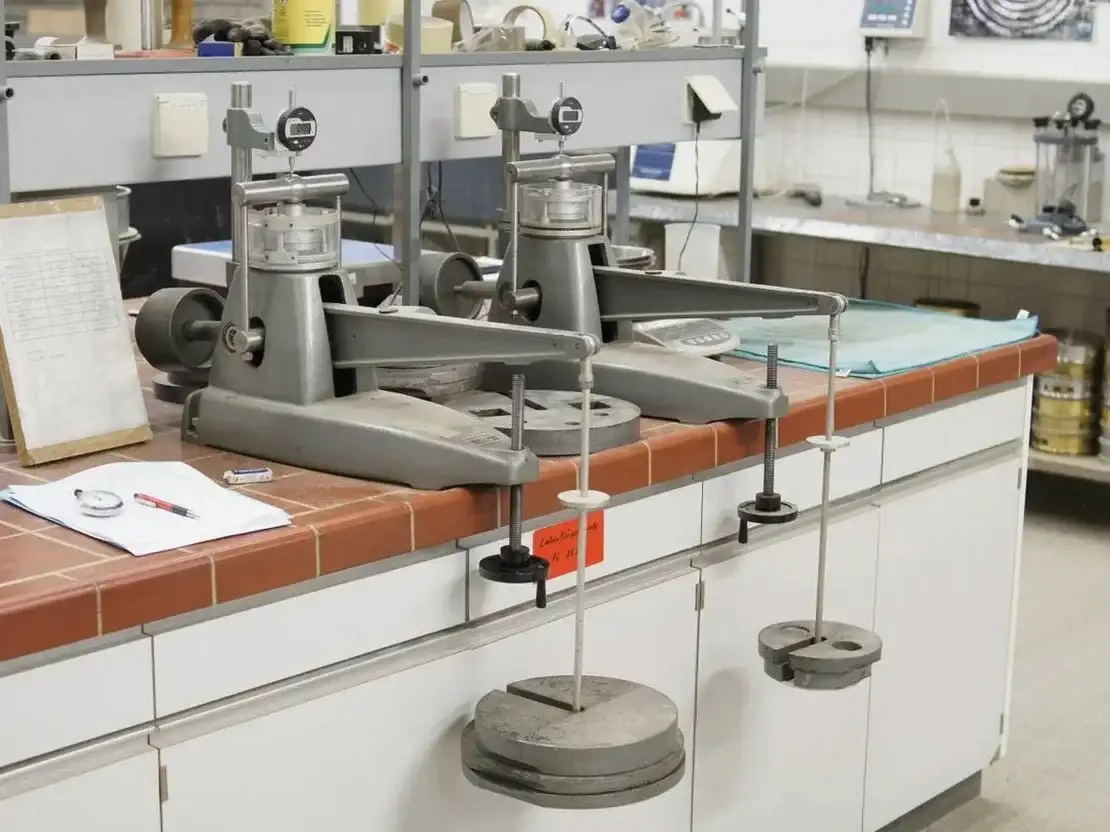
In Baltimore, falling head tests on fine-grained soils yield the most reliable k-values for drainage design near the Inner Harbor.
Method and coverage
Regional considerations
We have seen projects in Fells Point where contractors assumed a uniform soil permeability of 10⁻⁴ cm/s based on regional maps, but our lab tests on samples from the same depth showed values closer to 10⁻⁶ cm/s in the clay lenses. That difference turned a simple trench drain design into an underdrain system with geotextile wrap, adding weeks to the schedule. Conversely, in Locust Point the constant head tests revealed free-draining sands with k exceeding 10⁻² cm/s, which allowed the team to reduce the number of sump pumps by half. Ignoring the lab data either way leads to either over-engineered costs or under-designed drainage that floods basements during the region's heavy spring rains.
Standards that apply
ASTM D2434-19 (Constant Head Permeability), ASTM D5856-15 (Falling Head Permeability), ASTM D422-63 (Sieve Analysis, for sample characterization)
Related services
Constant Head Permeability Test
Applied to clean sands and gravels with k > 10⁻⁴ cm/s. Uses a 100 mm diameter permeameter, steady flow at three hydraulic gradients, and temperature correction to 20 °C. Results include the coefficient of permeability and void ratio at test conditions.
Falling Head Permeability Test
Designed for silts and clays where flow rates are low. The sample is confined in a 70 mm tube, saturated under vacuum, and water level drop is recorded over time. We calculate k from the time-discharge relationship and report the value alongside the initial void ratio and degree of saturation.
Typical parameters
Common questions
What is the difference between constant head and falling head permeability tests?
Constant head tests maintain a steady water level difference across the sample, measuring the volume of flow over time, and are best for sands and gravels. Falling head tests measure the rate at which water level drops in a standpipe, suitable for silts and clays where flow is slow. Both follow ASTM D2434 and ASTM D5856, respectively.
How much does a laboratory permeability test cost in Baltimore?
The typical range for a single laboratory permeability test in Baltimore is between US$470 and US$610, depending on the method (constant or falling head) and whether remolding or trimming is required. This includes saturation, testing at three gradients, and a written report with k-values and void ratio. Volume discounts apply for multiple samples from the same project.
Why is a laboratory permeability test needed if I already have grain size data?
Grain size correlations (Hazen, Kozeny-Carman) give only approximate k-values, often off by one or two orders of magnitude. In Baltimore's heterogeneous soils, where clay lenses and silt seams are common, a direct permeability test captures the actual fabric and void ratio under controlled saturation, which is critical for drainage design and dewatering plans.
How long does it take to get results from a lab permeability test?
A constant head test on sand usually takes 2 to 3 days, including sample preparation and saturation. Falling head tests on clay may take 4 to 5 days because of the slower flow rates and need for full saturation. We provide preliminary values by day 3 for falling head tests, with the final report within 5 business days.
Can you run permeability tests on disturbed samples or only on intact cores?
We can test both. Intact Shelby tube samples preserve the natural fabric and are preferred for undisturbed k-values. For bulk disturbed samples, we remold the soil to the target density and moisture content, then run the test. The report clearly states whether the sample was intact or remolded so you can interpret the results appropriately.