The triaxial cell sits on the loading frame in our Baltimore lab, a specimen of saturated clay from the Patapsco River valley carefully sealed inside a rubber membrane. We apply a confining pressure that mimics the overburden at 15 feet depth, then ramp up the deviator stress until the sample fails along a clean shear plane. This test tells us the effective stress parameters c' and φ' that every foundation engineer in Baltimore needs before signing off on a mat foundation or a deep pile group. Before we run the triaxial, we often coordinate with a granulometry analysis to ensure the soil classification matches the expected behavior under load.
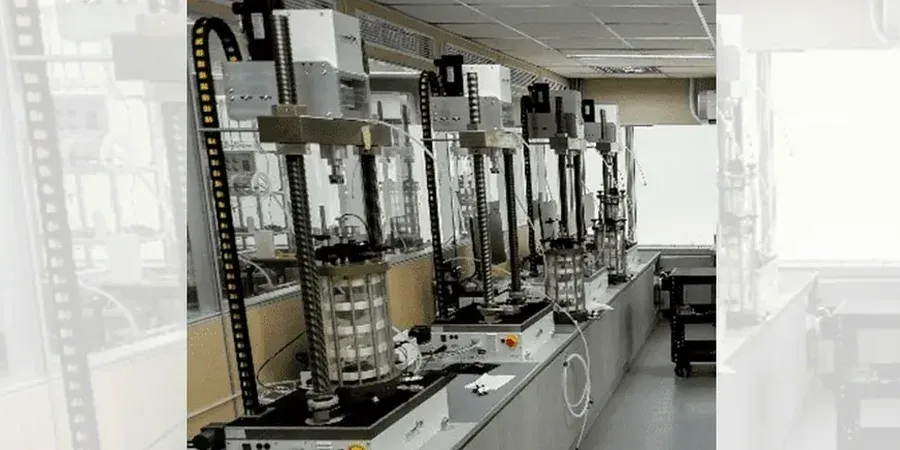
A single triaxial test on Baltimore clay can reveal whether your foundation needs a 4-foot mat or a 40-foot pile group.
Method and coverage
- Effective cohesion (c') and friction angle (φ') from CU tests
- Undrained shear strength (Su) from unconsolidated-undrained (UU) tests
- Deformation modulus E50 at 50% of peak stress
- Pore pressure parameter A at failure
Regional considerations
The humid Chesapeake climate keeps Baltimore's near-surface soils at moisture contents near the plastic limit year-round. When we extract Shelby tube samples from a site in Fells Point, the clay can lose moisture within hours if not sealed properly. That moisture loss alters the effective stress history and can give you a friction angle 3 to 5 degrees higher than reality. We mitigate this by trimming and mounting specimens inside a humidity-controlled chamber within 30 minutes of extrusion, then back-pressure saturating to a B-value of 0.96 or higher before shearing. Ignore this step and your design might overestimate bearing capacity by 20 percent.
Standards that apply
ASTM D2850-15 (UU triaxial on cohesive soils), ASTM D4767-11 (CU triaxial with pore pressure measurement), ASTM D7181-11 (CD triaxial for drained parameters)
Related services
Consolidated-Undrained (CU) Triaxial with Pore Pressure Measurement
For deep foundations and embankments where long-term drained behavior controls the design. We saturate the specimen, consolidate it under the estimated in-situ effective stress, then shear it at a controlled rate while recording pore pressure. This yields effective stress parameters c' and φ' that are essential for slope stability and retaining wall design in Baltimore's Piedmont residual soils.
Unconsolidated-Undrained (UU) Triaxial for Short-Term Stability
For rapid construction scenarios like excavation support or temporary shoring in Baltimore's coastal plain deposits. We shear the specimen immediately after applying confining pressure, without allowing drainage. The result is the undrained shear strength Su, which directly controls the short-term bearing capacity of shallow foundations on saturated clay near the harbor.
Typical parameters
Common questions
How long does a triaxial test take in your Baltimore lab?
A UU test on a single specimen takes about 2 to 4 hours including setup and saturation check. A CU test with pore pressure measurement takes 3 to 5 days because of the consolidation phase, which can last 24 to 72 hours depending on the clay's permeability. We prioritize Baltimore projects with a typical turnaround of 5 business days for CU and 2 days for UU.
What is the typical cost range for a triaxial test in Baltimore?
The typical cost for a triaxial test in Baltimore ranges from US$1,920 to US$2,520 per specimen, depending on the test type (UU, CU, or CD) and whether pore pressure measurements are required. This includes specimen preparation, saturation verification, shearing, and a detailed report with stress-strain curves and Mohr circles. Volume discounts apply for projects requiring 6 or more specimens.
Why do I need effective stress parameters from a CU test instead of just a UU test?
For long-term stability problems like slope failures, retaining wall backfill, or deep foundation design, the drained strength governs because pore pressures dissipate over time. The CU test with pore pressure measurement gives you c' and φ' that represent the soil's true drained behavior. A UU test only gives undrained strength Su, which is relevant for short-term conditions during construction but can overestimate long-term capacity by a factor of 2 or more in Baltimore's plastic clays.
How do you handle sensitive Baltimore clays that might be disturbed during sampling?
We use thin-walled Shelby tubes with a 2-inch diameter and a careful push rate of 10 to 20 mm/s to minimize disturbance. Once the tube reaches the lab, we extrude the sample in a controlled environment, trim it with a wire saw, and mount it in the triaxial cell within 30 minutes. We then back-pressure saturate to a B-value of 0.96 or higher before testing. If the sample shows visible disturbance or cracks, we reject it and request a replacement. This protocol follows the best practices outlined in ASTM D4767 and is standard for all Baltimore projects.