Baltimore's subsurface conditions vary significantly from the Inner Harbor's soft estuarine deposits to the weathered schist and gneiss of northern neighborhoods. In practice, this means pavement design must account for abrupt transitions in subgrade support. A thorough geotechnical investigation for road projects here starts with classifying the soil profile, often combining test pits with a granulometry analysis to determine if the material behaves more like a granular base or a fine-grained silt-clay. Without this step, even well-designed asphalt sections can fail prematurely due to differential settlement or inadequate drainage.
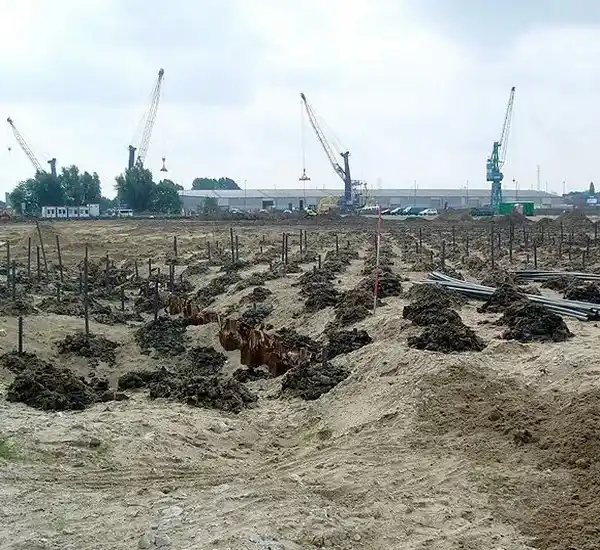
Baltimore's freeze-thaw cycles can reduce subgrade CBR by 40 to 60 percent if the soil is a high-plasticity silt-clay.
Method and coverage
- California Bearing Ratio (CBR) at 0.1 and 0.2 inch penetration
- Maximum dry density and optimum moisture content via modified Proctor (ASTM D1557)
- Liquid limit and plasticity index (ASTM D4318) to identify expansive clays
Regional considerations
Much of Baltimore's older road infrastructure was built atop uncompacted fill and historical mill tailings. These layers can contain organic matter, debris, and voids that cause localized pavement failures years after construction. The risk is highest along the Jones Falls valley and the Patapsco River corridor, where alluvial silts and soft clays dominate. Ignoring the subgrade's collapse potential — especially when the groundwater table rises within 1.5 meters of surface — can lead to pumping, rutting, and longitudinal cracking within the first three service years. A targeted road geotechnics program with moisture-density control and soaked CBR testing is the only reliable way to quantify these hazards before placing pavement.
Standards that apply
ASTM D1883-21 (CBR), AASHTO T-307 (Resilient Modulus), ASTM D1557 (Modified Proctor), AASHTO M 145 (Soil Classification for Pavements)
Related services
Subgrade Exploration & Classification
Test pits and boreholes to characterize soil stratigraphy, classify material per USCS/AASHTO, and identify problematic layers such as organic silts or expansive clays.
CBR & Resilient Modulus Testing
Soaked and unsoaked CBR tests plus repeated load triaxial (AASHTO T-307) to determine stiffness parameters for mechanistic pavement design.
Compaction Control & Density Verification
Nuclear gauge and sand cone density tests per ASTM D6938 and D1556 to ensure fill layers meet specified compaction requirements.
Pavement Section Design Recommendations
Layer thickness calculations using AASHTO 1993 or MEPDG, with sensitivity analysis for high-traffic corridors and low-volume residential streets.
Typical parameters
Common questions
What is the typical CBR value for Baltimore subgrade soils?
Soaked CBR values in Baltimore range from 2% in soft alluvial clays near the harbor to 15% in the weathered schist of northern suburbs. The most common PI values fall between 15 and 30, indicating moderate to high plasticity.
How does road geotechnics differ between Baltimore's urban and suburban projects?
Urban projects often encounter buried utilities, old foundations, and compacted fill from the 19th century, requiring careful test pit planning. Suburban projects typically involve cut-and-fill on residual soils, where the main challenge is achieving uniform compaction across varying moisture conditions.
What is the cost range for a road geotechnics study in Baltimore?
A standard investigation including test pits, CBR testing, Proctor compaction, and AASHTO classification typically ranges between US$860 and US$4,130, depending on the number of test locations and the depth of exploration required.