Under ASCE 7-22 and IBC 2021, every structure in Baltimore must be assigned a seismic site class based on VS30 measurements of the upper 100 feet. The city's coastal geology — a mix of Pleistocene terrace deposits, alluvial silts, and deep Cretaceous clays — produces shear wave velocities that vary sharply within a single block. MASW (Multichannel Analysis of Surface Waves) captures that variability by recording Rayleigh wave dispersion along a 2D array, yielding a continuous 1D or 2D velocity profile without boreholes. This non-invasive method is especially relevant in Baltimore, where buried stream channels and filled tidal marshes create velocity inversions that a single SPT blow count would miss. A reliable VS30 value supports seismic design of foundations, retaining walls, and pile-supported structures in the Inner Harbor and Fells Point districts.
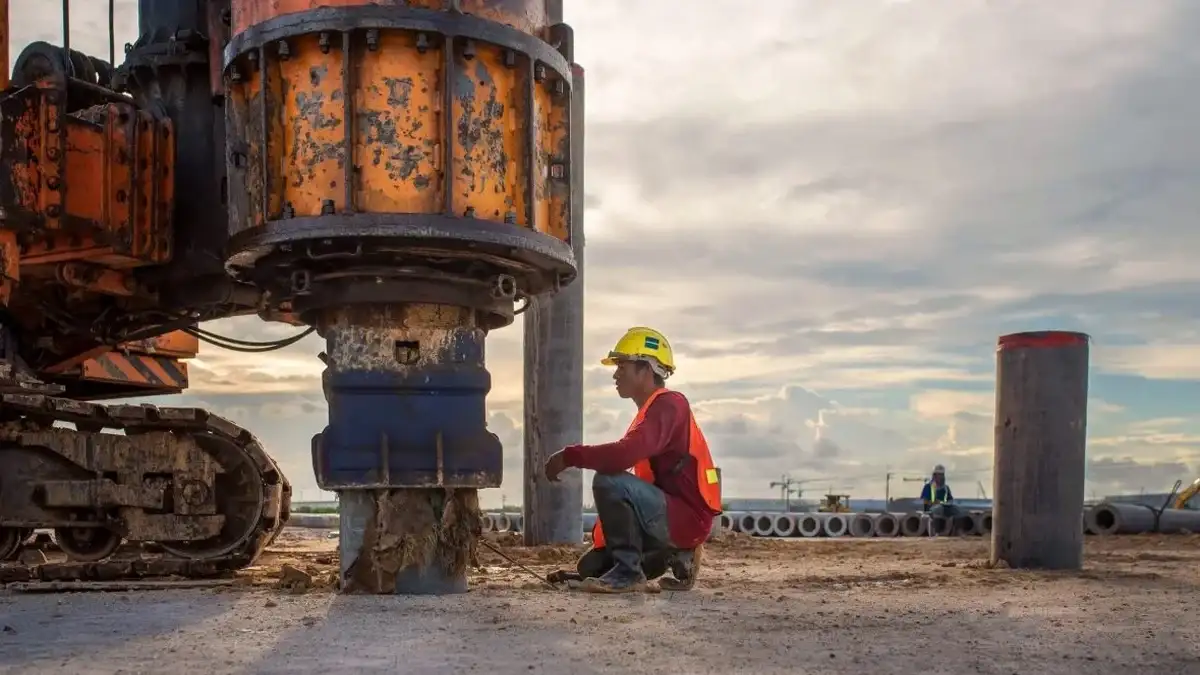
A single MASW profile can resolve velocity inversions hidden by SPT alone, critical for sites on Baltimore's filled tidal marshes.
Method and coverage
Regional considerations
Compare two blocks in Canton — one over natural Pleistocene sand (VS30 ~400 m/s, site class C) and another only 200 meters away over a filled former ship slip (VS30 ~240 m/s, site class D). A building designed with the same seismic base shear on both would be under-designed on the fill. The difference stems not from soil strength but from shear wave velocity: softer sites amplify long-period motions more severely. For downtown Baltimore, where many structures are 10+ stories on spread footings, misclassifying the site can lead to dangerous underestimation of drift demands. A focused MASW line across the property boundary catches the transition, allowing the structural engineer to adjust the response spectrum coefficient (Fa, Fv) per ASCE 7 Table 11.4-1.
Standards that apply
ASCE 7-22 – Seismic site classification per Chapter 20, ASTM D4428 – Standard Test Methods for Crosshole Seismic Testing, NEHRP Recommended Seismic Provisions (FEMA P-1050), IBC 2021 – Site class requirements in Section 1613
Related services
2D MASW Profile
Single-line roll-along survey for linear infrastructure, foundation footprints, or site-wide seismic classification. Includes dispersion curve picking and inversion to 35 m depth.
1D VS30 Measurement
Targeted 1D profile at a single geophone array for quick site class determination. Ideal for small projects or as a complement to existing boreholes.
MASW + SPT Integration
Combined field campaign where MASW lines are calibrated against SPT N-values and lab-measured unit weights. Provides both velocity and strength data for foundation design.
Liquefaction Screening (VS-based)
Using the MASW velocity profile to evaluate cyclic resistance ratio (CRR) per Youd et al. (2001). Outputs a factor-of-safety map for loose to medium sands in Baltimore's coastal areas.
Typical parameters
Common questions
How is MASW different from the seismic CPT or downhole method?
MASW uses surface waves (Rayleigh waves) recorded by a linear geophone array, providing a 2D velocity profile over a depth of 25–50 m without a borehole. Seismic CPT and downhole methods require a pre-drilled hole and measure P and S waves only at discrete depths. MASW is faster and cheaper for large areas, while CPT gives continuous tip resistance alongside velocity.
What VS30 values are typical for Baltimore's different neighborhoods?
In areas with deep Pleistocene sand and gravel (e.g., Roland Park, Mount Washington), VS30 often exceeds 400 m/s, placing them in site class C. Downtown and the Inner Harbor, where fill over soft clay is common, typically yield VS30 between 200 and 300 m/s (site class D). The transition can be abrupt, so a single MASW line is recommended per 0.5 acre parcel.
How long does a MASW survey take on a typical Baltimore site?
For a standard 72 m array with 24 geophones, field deployment and data collection take about 2 hours. Inversion processing and report generation require another 2–3 working days. Total turnaround for a single profile is 5–7 business days from mobilization.
Do I need a MASW survey if I already have SPT boreholes?
SPT blow counts do not directly measure shear wave velocity. ASCE 7 allows site class assignment based on SPT N-values only for site class A through D, but the correlation is weak. MASW provides the VS30 value required for accurate Fa and Fv factors, and it can detect velocity inversions (e.g., loose fill over stiff clay) that SPT alone may miss. For Baltimore's filled waterfront sites, MASW is strongly recommended.